Laman ini menggunakan cookies untuk memastikan Anda mendapatkan pengalaman terbaik. Informasi lebih lanjut perihal informasi yang dikumpulkan dan digunakan silakan lihat Kebijakan Cookie dan Kebijakan Privasi
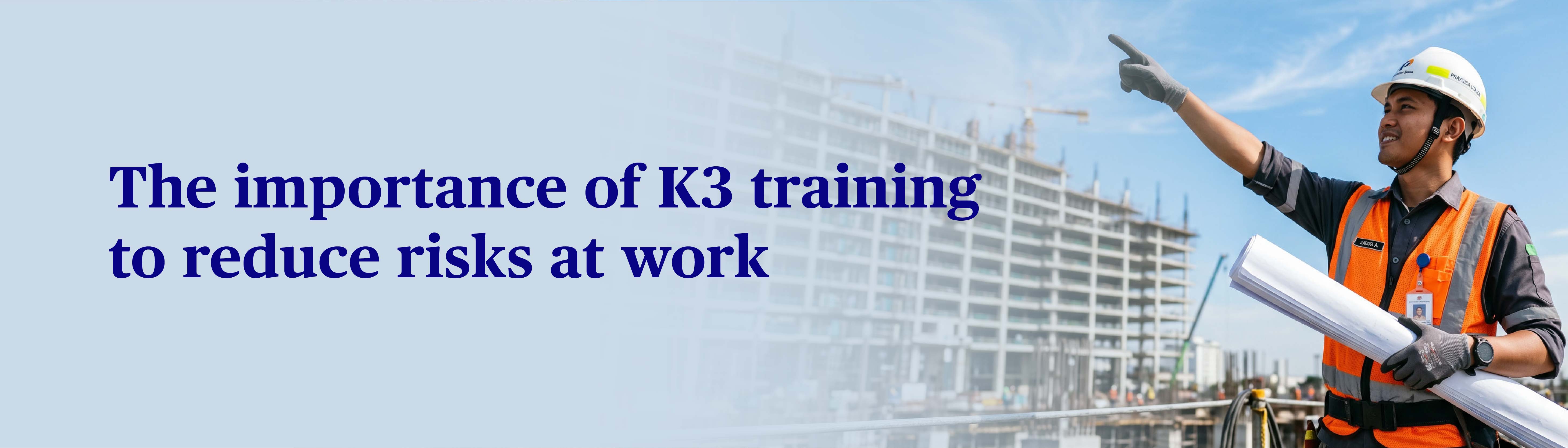
In the work environment, the risk of a work accident is never 0%. Because of one thing or another, there are always risks, so it is important to get K3 training for every employee in your work area.
Looking a little at the understanding of K3, officially Law No. 1 of 1970 concerning Occupational Safety is defined as all activities to ensure and protect occupational safety and health through efforts to prevent accidents and occupational diseases.
K3 training is then aimed at providing readiness to each employee for existing work risks, in order to reduce the possibility of this happening. K3 is a shared responsibility so that the number of work accidents can continue to be suppressed.
You can pay attention to some points about the importance of K3 training below.
This training helps employees to know and understand the existence of risks in the workplace, as well as how to avoid them. Trained employees will have higher alertness, the ability to use protective equipment, and know what to do when an emergency arises.
From the company's side, K3 training will reduce the number of work accidents that occur, reduce medical costs, and insurance claims. At the same time, the company's image in the eyes of the public will also be better because it shows its seriousness in the protection and safety of all employees.
If you look at data from BPJS Ketenagakerjaan, companies that routinely conduct K3 training for their employees recorded a significant decrease in the number of work accidents reaching 40%.
Another study from the Ministry of Manpower also shows that companies that have an ideal K3 management system tend to have lower employee absenteeism rates, because work accidents are less common.
This means that K3 training can bring productive benefits to the business owned.
Effective training will have a direct impact on increasing the work productivity of each employee. Why?
Because employees who are trained and understand occupational safety procedures can work with focus without worrying about hazards in the workplace. A conducive environment is created, so that disturbances or accidents that arise to hinder work can be prevented.
From a financial perspective, companies that implement K3 training well will also reduce work accidents that can save costs for medical treatment or workers' compensation.
In many regulations that apply in Indonesia, K3 training is a mandatory thing for companies. This training helps companies stay compliant with applicable regulations, as well as avoid legal sanctions.
K3 training can help companies to build a culture that cares about occupational safety and health. This is more than just following regulations and procedures, but it is about internalizing K3 values in every aspect of work.
Thus, the elements of occupational safety and health will be an important part of each part of the company.
A little has been mentioned in the first part about the benefits of K3 training for employees and companies. You can look deeper related to the benefits for employees, here.
K3 training will equip employees with the ability to recognize potential hazards that exist. By understanding the risks and how to control them, the possibility of work accidents can be significantly reduced.
Employees who have participated in K3 training tend to be more disciplined and comply with work procedures. The use of personal protective equipment or PPE is also not a problem when needed, so that a safe and minimal risk work environment is created.
K3 training also plays a role in preventing work-related diseases such as respiratory disorders, hearing loss, and ergonomic problems. Employees will understand a healthier way of working so that the load on their bodies will be reduced.
A safe work environment will create a sense of comfort for employees. By participating in this training, employees will feel more protected and appreciated by the company so that they can increase loyalty and work motivation.
Observing some of the general K3 expert training materials recognized by the National Professional Certification Agency, the subject matter of K3 training is divided into 10 different points.
This material dwells on the basic concepts of K3, definition, goals, and urgency of K3 in the workplace. Learning the history of development, basic principles, and roles and responsibilities in the implementation of K3 in the workplace will be carried out to become the foundation of all K3 activities.
The K3 laws and regulations that apply in Indonesia are the main material. This is related to the Manpower Law and other regulations related to K3. The trainees will also learn about the rights and obligations of employees and companies in the context of K3.
K3 training participants will be taught how to identify different types of hazards that exist in the workplace. These hazards include physical hazards, chemical hazards, biological hazards, and ergonomic hazards. Material on techniques to recognize hazards will be the main menu at this point.
Furthermore, material is provided on risk analysis to assess the level of danger and determine appropriate control measures. This analysis includes an assessment of the likelihood and impact of existing risks, and risk analysis methods including relevant matrices.
This fifth material includes safety management principles. Included in the discussion are the planning, implementation, monitoring, and evaluation of the K3 program in general.
Employees will learn management techniques to ensure that their K3 programs can run effectively and efficiently. This material will also discuss strategies for developing a safety culture in your workplace.
Hazard control will be the sixth material, where employees will recognize various existing hazard control methods.
Some of the most basic methods are:
In this material, employees will also learn how to use PPE as one of the methods that can be done for final control.
The seventh material is related to the reporting of work accidents, as well as investigation methods to find what is the cause of it. The goal is simple, so that employees can find out what the root of the problem is, and not let it happen in the future.
Employees will be taught how to accumulate evidence, analyze existing data, and create comprehensive investigative reports, complete with cause-and-effect analysis.
Readiness is not only built with audio-visual materials, but also by simulating emergencies to practice skills in dealing with emergency conditions.
Some of the simulations that are usually carried out are simulations of fires, chemical spills, evacuations, and the like. Thus, employees have real experience in practicing their readiness, and can minimize the impact that arises.
After getting the various materials above, employees will also get material about PPE and everything related to it. Introduction to the types of PPE, how to use it correctly, and the care and maintenance of PPE to ensure its effectiveness.
Understanding the importance of PPE in protecting workers from risks cannot be eliminated through technical or administrative control. The basic thing is to select PPE that is in accordance with the type of danger faced.
The ergonomic principle itself is a principle applied to create a comfortable and safe work environment, and can reduce the risk of injury due to ergonomic factors. The material ranges from work posture, workplace design, to techniques to reduce the workload physically.
Basically, K3 training carried out in the workplace is aimed at ensuring that the level of occupational safety can be maintained and has maximum value. Not only so that the business continues to run smoothly, but also in order to ensure the safety of employees in the work environment from various existing risks.
If you belong to the employee category, then awareness of the importance of K3 training must also be in you. This basic ability can have a significant impact when something undesirable happens, so that the effects that appear can really be suppressed even to a minimal number.
This awareness should also be supported by the right insurance products, such as SmartActive Personal Accident Insurance offered by AXA Insurance Indonesia. The protection provided is protection from various risks when composing, being and returning from work. The combination of careful preparation by taking K3 training and having the right insurance is perfect to help you work more comfortably, safely, and focus to achieve your goals!
References: